Assessment
How biomechanical assessment works, what it measures, and why it changes outcomes. Range of motion testing, structural pattern classification, and assessment methodology.
Ankle Mobility for Deeper Squats: What You Are Actually Missing
Limited squat depth is blamed on tight ankles. The real limitation is usually the hip, the rib cage, or the way your nervous system organizes the squat pattern — not the ankle joint itself.
Biomechanical Assessment vs FMS: What Is the Difference?
The Functional Movement Screen and a biomechanical assessment look similar from the outside. They are fundamentally different in what they measure, what they tell you, and what they miss.
Fix Bunions Without Surgery: A Structural Approach
Bunions are not a genetic foot deformity. They are a progressive structural failure driven by hip mechanics, arch collapse, and hallux compensation. Surgery addresses the result, not the cause.
Chin Tucks Will Not Fix Forward Head
Forward head posture is not a neck problem. It compensates for thoracic kyphosis and breathing dysfunction. Fix the cause, the head follows.
Hip Pain From Sitting All Day: The Real Mechanism
Sitting does not damage your hips. What damages them is the pelvic position your body adapts to — and the movement capacity it loses in the process.
Knee Pain When Running: It's Not Your Knees
Runner's knee is blamed on weak quads and worn cartilage. The real cause is almost always hip mechanics and foot control that the knee has to compensate for.
Lower Belly Pooch Is Not Body Fat
That lower belly pooch at low body fat? It is anterior pelvic tilt creating a visual illusion. The biomechanical fix trainers never consider.
Neck Pain From Sleeping: Why Your Pillow Is Not the Problem
Waking up with neck pain is not a pillow problem. It is a cervical spine and thoracic position problem that your sleeping posture reveals rather than creates.
Plantar Fasciitis: Your Feet Are the Victim
Plantar fasciitis treatments target the foot. The real cause is upstream: hip mechanics drive knee position, which drives ankle and foot overload.
Fix Rounded Shoulders Permanently
Rounded shoulders are not a chest tightness problem. They are a rib cage and thoracic spine problem. Stretching your pecs will not fix what your ribs created.
Sciatica: The Structural Cause Nobody Treats
Most sciatica treatment targets the disc or the nerve. The real problem is usually pelvic position and hip mechanics that compress the nerve root or piriformis before the disc is even involved.
Exercise With Scoliosis: What Works and What Makes It Worse
Scoliosis does not prevent you from training. But training without understanding your curve pattern will reinforce the asymmetry instead of correcting it.
Shoulder Pain Is Not a Shoulder Problem
Shoulder impingement is rarely a rotator cuff problem. The real drivers are thoracic spine mobility, rib position, and scapular control.
Fix Thoracic Kyphosis: The Foundation Everyone Ignores
Thoracic kyphosis correction fails when you treat it as a stretching problem. It is a rib cage position and breathing mechanics problem that requires a different approach entirely.
Stop Stretching Your Hip Flexors
Your hip flexors feel tight but they are not short. They are overworking because your glutes and core have checked out. Here is what is actually happening.
Wrist Pain From Typing: The Problem Starts at Your Shoulder
Carpal tunnel and wrist pain in desk workers is blamed on the wrist. The real drivers are thoracic position, shoulder mechanics, and nerve tension through the entire upper limb chain.
Why Every CrossFit Athlete Needs a Structural Assessment Before Programming
CrossFit demands full-body ROM. A structural assessment reveals which positions you own and which ones are injuring you. Data, not guessing.
Biomechanical Assessment for Golfers: Hip IR, Thoracic Rotation, and Your Swing
How hip internal rotation and thoracic mobility directly control your golf swing. Assessment protocols, normal ranges, and correction strategies.
Shoulder Internal Rotation Deficit (GIRD): Assessment, Causes, and Correction
GIRD explained for coaches and athletes. How to measure it, what causes it, when it matters, and a structured correction protocol with timelines.
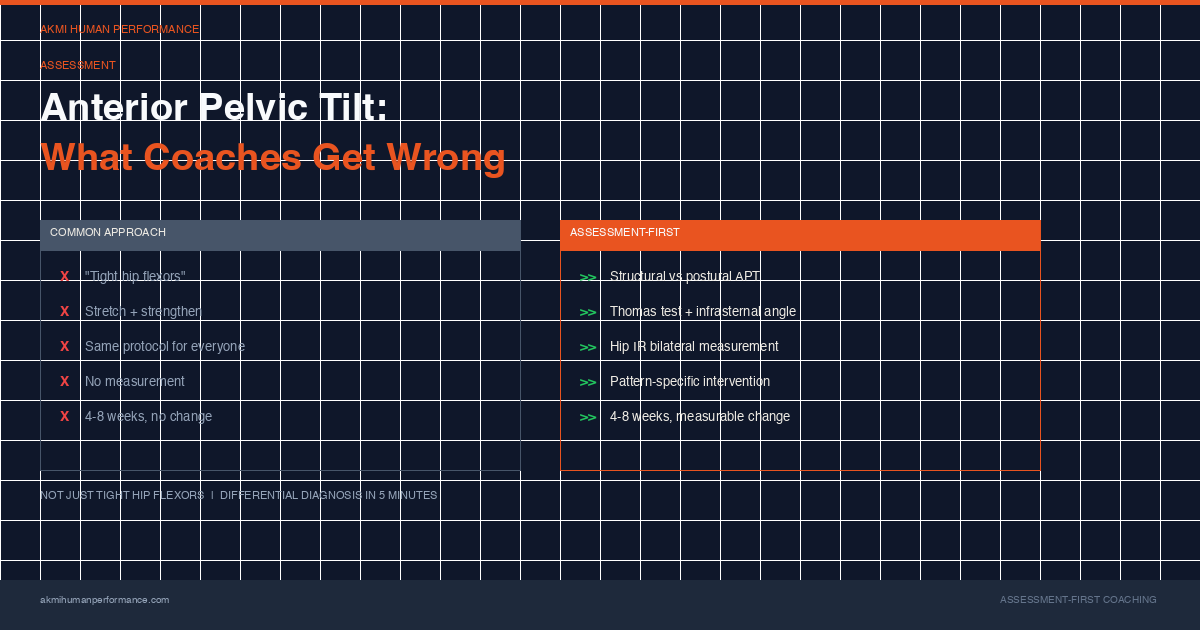
APT Assessment: What Coaches Miss
Anterior pelvic tilt is not caused by tight hip flexors. The assessment-first approach changes the diagnosis and the fix. Here is what the data shows.
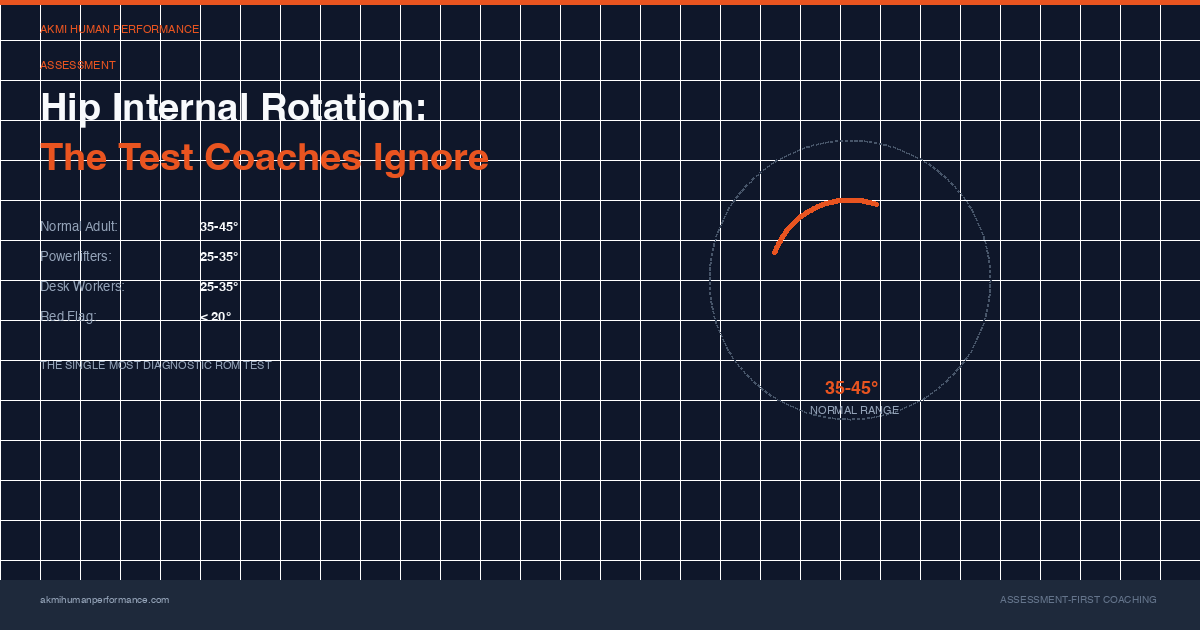
Hip Internal Rotation Guide
Hip internal rotation reveals more about structural state than any other test. Normal ranges, measurement, asymmetries, and how to act on the data.
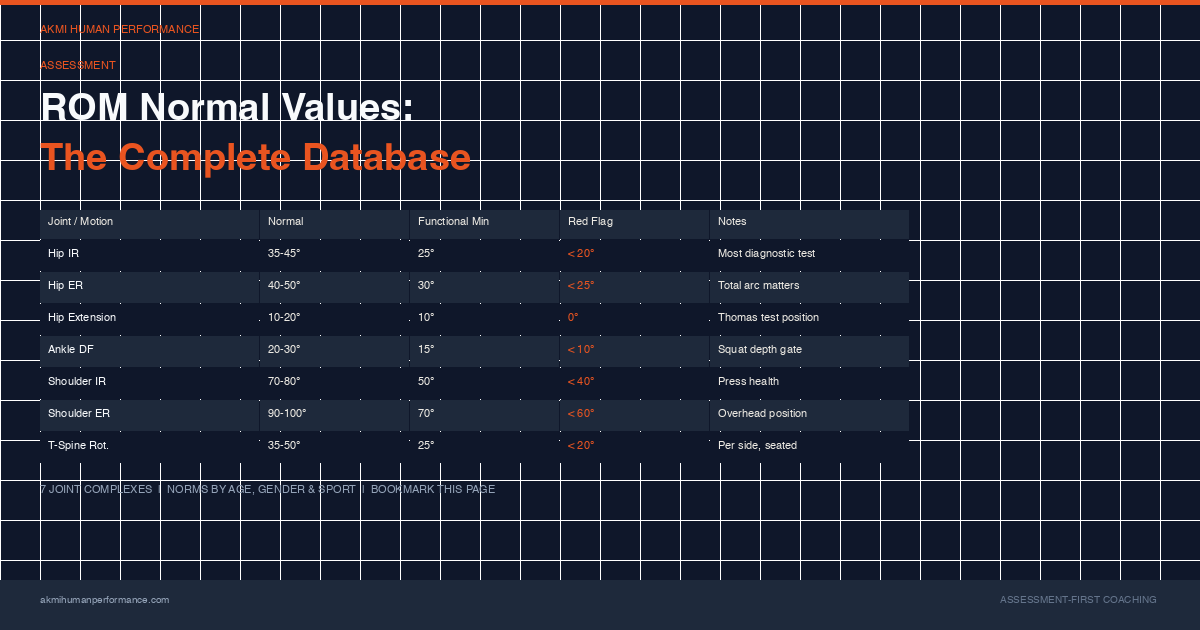
ROM Normal Values Database
Complete ROM norms by joint, age, gender, and sport. Hip, knee, ankle, shoulder, thoracic, cervical, and wrist in one bookmarkable reference.
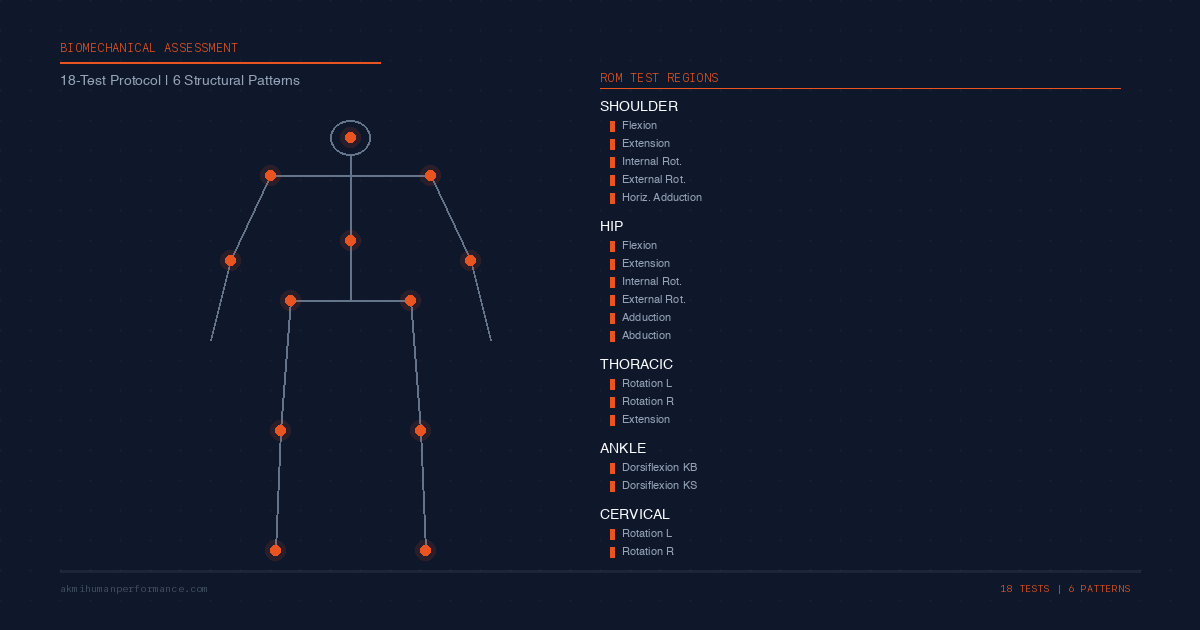
What Is Biomechanical Assessment?
How a biomechanical assessment measures your body joint by joint. What it tests, why it matters, and how coaches use it to build programs that work.
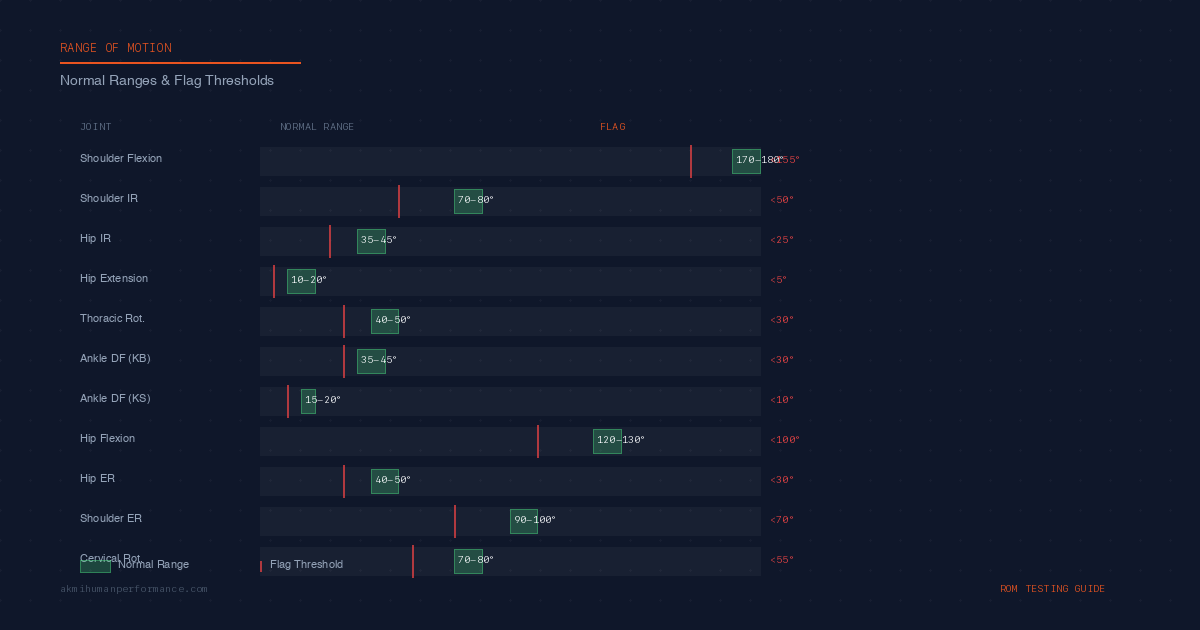
ROM Testing Guide for Coaches
Practical guide to range of motion testing. Which joints to test, what the numbers mean, and how ROM data changes your programming decisions.
Ready to get assessed?
18 range of motion tests. 6 structural patterns. A training program built on what your body actually needs.