ROM Normal Values Database
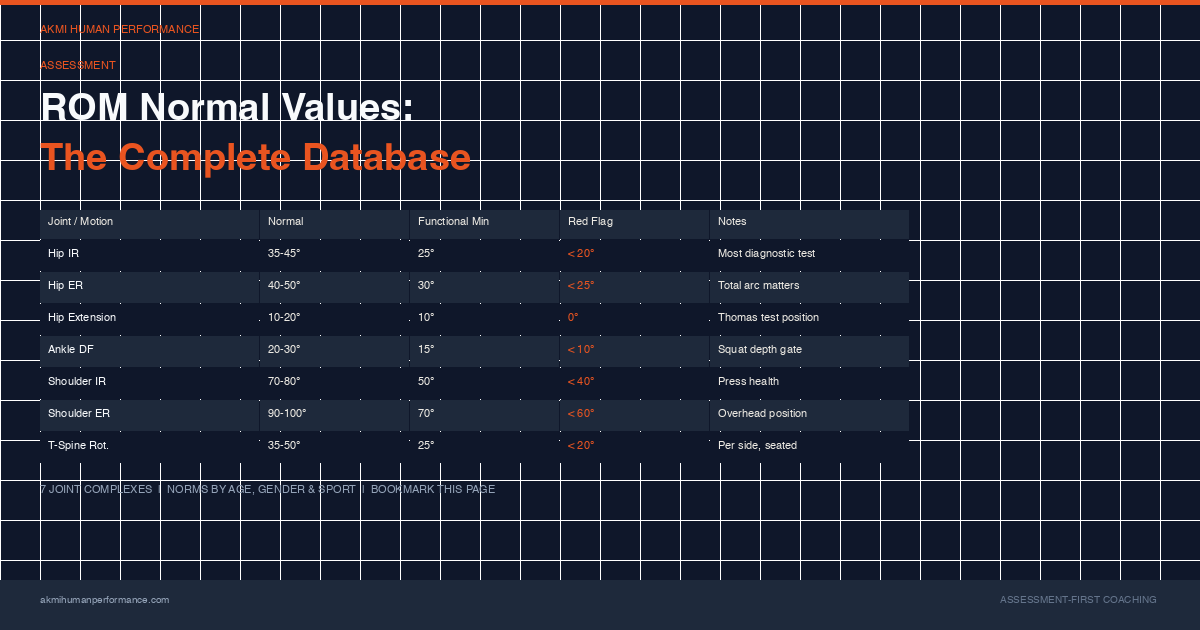
Complete ROM norms by joint, age, gender, and sport. Hip, knee, ankle, shoulder, thoracic, cervical, and wrist in one bookmarkable reference.
Why you need a ROM reference you can trust
Range of motion data is scattered across textbooks, research papers, clinical manuals, and outdated websites that cite each other in circles. If you search for “normal hip internal rotation,” you will find answers ranging from 25 degrees to 50 degrees depending on the source, the testing position, the population, and whether the author measured active or passive range.
This article consolidates ROM norms from peer-reviewed literature (American Academy of Orthopaedic Surgeons standards, Norkin & White clinical measurement texts, Boone & Azen population studies, and our own database of 500+ assessments) into a single, practical reference. Every value specifies the testing position, the type of motion (active vs. passive), and the population it applies to.
Bookmark this page. You will use it.
How to read these tables
Each table follows the same format:
- Motion: The joint movement being measured
- Normal range: The expected range for a healthy adult (18-60), passive measurement unless noted
- Functional minimum: The minimum range needed for common movements (squat, press, deadlift, gait)
- Red flag: The value below which referral or modified programming is strongly recommended
- Notes: Testing position, common asymmetries, sport-specific considerations
All values are in degrees. Ranges represent population averages with typical standard deviations of 5-10 degrees. Individual variation is normal — the ranges are guidelines, not absolutes.
Hip
The hip is the most information-dense joint complex for coaching purposes. It drives lower body mechanics, pelvic position, and lumbar spine compensation. Six movements matter.
| Motion | Normal Range | Functional Minimum | Red Flag | Notes |
|---|---|---|---|---|
| Flexion | 120-135 | 110 (squat to parallel) | Below 90 | Tested supine, knee bent. Limited by hamstring if knee straight. |
| Extension | 10-20 past neutral | 10 (full gait stride) | 0 (cannot reach neutral) | Thomas test position. Most undertested motion. Desk workers commonly lose this. |
| Internal rotation | 35-45 | 25 (symmetrical squat depth) | Below 20 bilateral | Tested seated, hip at 90 degrees flexion. The single most diagnostic ROM test. |
| External rotation | 40-50 | 30 (sumo stance, turnout) | Below 25 bilateral | Tested seated, hip at 90 degrees flexion. Total arc (IR+ER) matters most. |
| Abduction | 40-50 | 30 (wide stance, lateral movement) | Below 20 | Tested supine, knee straight. Often limited by adductor tone, not length. |
| Adduction | 20-30 | 15 (crossing midline, gait) | Below 10 | Tested supine. Rarely the primary constraint in coaching contexts. |
Hip rotation: the total arc concept
Individual IR and ER numbers are useful. The total arc of rotation (IR + ER on each side) is more diagnostic. A healthy hip total arc is 75-95 degrees. The distribution within that arc tells the structural story.
| Total Arc | IR/ER Distribution | Structural Indication |
|---|---|---|
| 80 degrees (40 IR / 40 ER) | Balanced | Neutral pelvic position on this side |
| 80 degrees (25 IR / 55 ER) | ER dominant | Extension bias, pelvis anteriorly tilted on this side |
| 80 degrees (50 IR / 30 ER) | IR dominant | Flexion or internal rotation bias, pelvis posteriorly oriented |
| 55 degrees (20 IR / 35 ER) | Reduced total arc | Capsular restriction, possible degenerative change if age >50 |
| 110 degrees (55 IR / 55 ER) | Excessive total arc | Hypermobility, possible ligamentous laxity |
Hip ROM by age
| Age Group | Flexion | Extension | IR | ER | Total Arc |
|---|---|---|---|---|---|
| 18-29 | 130-140 | 15-20 | 40-50 | 45-55 | 85-105 |
| 30-39 | 125-135 | 12-18 | 35-45 | 40-50 | 75-95 |
| 40-49 | 120-130 | 10-15 | 30-40 | 35-45 | 65-85 |
| 50-59 | 115-125 | 8-12 | 25-35 | 30-40 | 55-75 |
| 60-69 | 110-120 | 5-10 | 20-30 | 25-35 | 45-65 |
| 70+ | 100-115 | 0-8 | 15-25 | 20-30 | 35-55 |
The decline in total arc with age is well-documented and gradual. A 55-year-old with a total arc of 50 degrees is within expected range. A 30-year-old with the same measurement warrants investigation.
Hip ROM by sport
| Sport | IR (typical range) | ER (typical range) | Notable Asymmetries |
|---|---|---|---|
| Powerlifting | 25-35 | 45-55 | ER dominant bilateral (extension training bias) |
| Olympic weightlifting | 35-45 | 40-50 | More balanced than powerlifting (deep receiving positions maintain IR) |
| Running | 30-40 | 35-45 | Can develop side-to-side asymmetry from repetitive unilateral loading |
| Soccer/football | 35-45 | 40-50 | Kicking leg often shows more IR on follow-through side |
| Baseball (pitchers) | 40-55 (lead) / 30-40 (trail) | 35-45 (lead) / 45-55 (trail) | Lead hip IR is higher, trail hip ER is higher — sport adaptation |
| Swimming | 40-50 | 45-55 | Generally higher total arc from kick mechanics |
| Ice hockey | 30-40 | 50-60 | ER dominant (skating stride demands external rotation) |
| Gymnastics | 45-55 | 50-60 | High total arc, hypermobility common |
Knee
The knee is simpler than the hip — two primary motions — but the functional minimums are strict.
| Motion | Normal Range | Functional Minimum | Red Flag | Notes |
|---|---|---|---|---|
| Flexion | 135-150 | 120 (full-depth squat) | Below 110 | Tested supine or prone. Post-surgical knees often plateau at 120-130. |
| Extension | 0 (full straight) to 5 (slight hyperextension) | 0 (must reach straight) | More than -5 (lacks 5 degrees of full extension) | Tested supine with heel propped. Extension deficit is more functionally limiting than flexion deficit. |
Knee flexion considerations
Knee flexion above 135 degrees is rarely the bottleneck in coaching. When a client cannot squat deep, the hip and ankle are almost always the constraint, not the knee. Knee flexion becomes the bottleneck only in post-surgical cases (ACL reconstruction, meniscectomy, total knee replacement) where scar tissue or swelling restricts bend.
Full knee extension (0 degrees) matters more than most coaches realize. A 3-5 degree extension deficit changes gait mechanics, increases quadriceps energy cost during standing, and can create compensatory hip hiking during walking. Always test and record extension, not just flexion.
Ankle
Ankle dorsiflexion is the gatekeeper of squat mechanics. It is also the easiest ROM to test and one of the most responsive to intervention.
| Motion | Normal Range | Functional Minimum | Red Flag | Notes |
|---|---|---|---|---|
| Dorsiflexion (knee straight) | 10-20 | 10 (heel contact during gait) | Below 5 | Gastrocnemius-limited. Tests the two-joint muscle. |
| Dorsiflexion (knee bent) | 20-30 | 15 (squat depth, landing) | Below 10 | Soleus-limited. The coaching-relevant test for squat depth. |
| Plantarflexion | 40-55 | 30 (push-off during gait) | Below 25 | Rarely limited in healthy populations. |
| Inversion | 30-40 | 20 (trail surface adaptation) | Below 15 | More relevant for sport than gym training. |
| Eversion | 15-25 | 10 (pronation during gait) | Below 5 | Limited eversion correlates with lateral ankle sprain history. |
The wall test for dorsiflexion
The weight-bearing lunge test (wall test) is the fastest way to screen ankle dorsiflexion. Client places foot flat on the floor, knee touches the wall. Measure the distance from the big toe to the wall at the farthest point where the knee can touch while the heel stays down.
| Distance from wall | Approximate dorsiflexion (knee bent) | Interpretation |
|---|---|---|
| Less than 5 cm | Less than 15 degrees | Restricted — will limit squat depth |
| 5-10 cm | 15-25 degrees | Adequate for most training |
| 10-15 cm | 25-35 degrees | Good mobility |
| More than 15 cm | More than 35 degrees | Above average, check for hypermobility |
Ankle ROM by gender
Women typically show 3-5 degrees more ankle dorsiflexion than men across all age groups. This is partly structural (ligament laxity, bone morphology) and partly habitual (footwear patterns). When comparing a female client’s dorsiflexion to norms, use the upper end of the range.
Shoulder
The shoulder complex has more degrees of freedom than any other joint. Five movements capture the coaching-relevant ROM.
| Motion | Normal Range | Functional Minimum | Red Flag | Notes |
|---|---|---|---|---|
| Flexion (overhead reach) | 170-180 | 160 (overhead press, pull-up) | Below 150 | Tested supine to eliminate lumbar extension compensation. Standing flexion inflates the number. |
| Abduction | 170-180 | 150 (overhead movements) | Below 140 | Often mirrors flexion restrictions. |
| Internal rotation (90/90) | 70-80 | 50 (bench press setup, behind-back reach) | Below 40 | Tested at 90 degrees abduction. Key for pressing health. |
| External rotation (90/90) | 90-100 | 70 (throwing, overhead position) | Below 60 | Tested at 90 degrees abduction. Total arc with IR matters. |
| Horizontal adduction | 130-140 | 100 (cross-body movement) | Below 90 | Posterior capsule tightness marker. Common in bench-heavy lifters. |
Shoulder total arc of rotation
Like the hip, the shoulder’s total rotation arc (IR + ER at 90 degrees abduction) is more diagnostic than individual numbers.
| Total Arc | Distribution | Interpretation |
|---|---|---|
| 160-180 | 70 IR / 90 ER | Normal, balanced shoulder |
| 180+ | Variable | Above average. Common in overhead athletes, gymnasts. |
| 160-180 | 40 IR / 130 ER | GIRD (Glenohumeral Internal Rotation Deficit). Common in throwers. Total arc preserved but shifted toward ER. |
| Below 140 | Variable | Capsular restriction. Evaluate for adhesive capsulitis if acute onset. |
Shoulder ROM in overhead athletes
Overhead athletes (baseball, tennis, volleyball, swimming) develop predictable adaptations in the dominant shoulder:
| Measurement | Dominant Arm (typical) | Non-Dominant Arm (typical) | Acceptable Asymmetry |
|---|---|---|---|
| External rotation | 95-115 | 85-95 | Up to 15 degrees more on dominant is normal |
| Internal rotation | 40-55 | 65-80 | Up to 20 degrees less on dominant (GIRD) |
| Total arc | 145-170 | 150-175 | Should be within 10 degrees bilateral |
The key clinical rule: total arc asymmetry greater than 10 degrees between arms is concerning regardless of how the individual numbers look. A dominant arm with 110 degrees ER and 40 degrees IR (total 150) compared to a non-dominant arm with 90 ER and 75 IR (total 165) shows a 15-degree total arc deficit. This correlates with shoulder injury risk in the literature.
Thoracic Spine
Thoracic rotation is the most undertested range of motion in coaching. It affects overhead mechanics, rotational sport performance, breathing, and shoulder health.
| Motion | Normal Range | Functional Minimum | Red Flag | Notes |
|---|---|---|---|---|
| Rotation (each side) | 35-50 | 25 (golf swing, throwing, rotational training) | Below 20 | Tested seated to eliminate hip contribution. Lumbar rotation is only 5-10 degrees — most trunk rotation is thoracic. |
| Extension | 20-30 (total thoracic) | 15 (overhead position, spinal health) | Below 10 | Difficult to isolate. Tested prone or quadruped. |
| Flexion | 30-40 (total thoracic) | 20 (forward bending tasks) | Excessive (>50) more concerning than limited | Rarely needs intervention in coaching. Excessive kyphosis is the issue, not limited flexion. |
Thoracic rotation asymmetry
Bilateral thoracic rotation should be within 5-8 degrees of symmetric. Asymmetry greater than 10 degrees suggests a rotational compensation pattern, often linked to pelvic rotation and rib position.
| Finding | Common Association |
|---|---|
| Left rotation greater than right | Left-oriented pelvic pattern (most common default) |
| Right rotation greater than left | Right-oriented or compensatory pattern |
| Bilateral restriction | Extension pattern, ribcage locked |
| Bilateral hypermobility | Flexible spine, check stability under load |
Cervical Spine
Cervical ROM matters for overhead lifters, contact sport athletes, and anyone with a desk job. The numbers are consistent across the literature.
| Motion | Normal Range | Functional Minimum | Red Flag | Notes |
|---|---|---|---|---|
| Rotation (each side) | 70-90 | 60 (shoulder check, pool turns) | Below 50, especially asymmetric | Tested seated, chin level. Asymmetry >10 degrees warrants investigation. |
| Flexion (chin to chest) | 45-50 | 35 | Below 25 | Limited flexion + pain = refer for imaging |
| Extension (look up) | 55-70 | 40 | Below 30, with symptoms | Age-related decline is significant. 70+ may have 30-40 degrees normally. |
| Lateral flexion (ear to shoulder) | 40-45 | 30 | Below 20 | Often asymmetric in desk workers (phone side vs. non-phone side) |
Cervical ROM by age
Cervical range of motion declines more steeply with age than any other spinal region. This is normal and important to account for.
| Age Group | Rotation (each side) | Flexion | Extension |
|---|---|---|---|
| 20-29 | 75-90 | 45-50 | 60-70 |
| 30-39 | 70-85 | 40-48 | 55-65 |
| 40-49 | 65-80 | 38-45 | 48-58 |
| 50-59 | 60-75 | 35-42 | 40-50 |
| 60-69 | 50-65 | 30-38 | 30-42 |
| 70+ | 40-55 | 25-35 | 25-35 |
A 65-year-old with 55 degrees of cervical rotation is normal. A 35-year-old with 55 degrees is restricted. Always compare to age-appropriate norms.
Wrist and Forearm
Wrist ROM matters for front rack position, push-ups, handstands, and any grip-intensive training.
| Motion | Normal Range | Functional Minimum | Red Flag | Notes |
|---|---|---|---|---|
| Extension (dorsiflexion) | 60-70 | 40 (push-up, handstand position) | Below 30 | Limiting factor for front rack in Olympic lifts |
| Flexion (palmar flexion) | 70-80 | 50 (general tasks) | Below 40 | Less commonly limited |
| Radial deviation | 15-25 | 10 | Below 5 | Relevant for racquet sports |
| Ulnar deviation | 30-40 | 20 | Below 15 | Relevant for golf, racquet sports |
| Forearm pronation | 75-85 | 60 | Below 50 | Test with elbow at side, bent 90 degrees |
| Forearm supination | 80-90 | 60 | Below 50 | Limited supination affects bicep curl position, overhead grip |
Gender differences across joints
Women generally show 3-8 degrees more passive ROM than men across most joints. This is consistent in the literature and has practical implications for norm comparison.
| Joint/Motion | Female Advantage (degrees) | Notes |
|---|---|---|
| Hip flexion | +5 to +10 | Pelvic morphology, ligament laxity |
| Hip IR | +3 to +5 | Femoral anteversion differences |
| Hip ER | +3 to +5 | Capsular laxity |
| Ankle dorsiflexion | +3 to +5 | Consistent across studies |
| Shoulder flexion | +5 to +8 | More pronounced overhead |
| Thoracic rotation | +3 to +5 | Less data available, trend is consistent |
| Cervical ROM | +2 to +5 | All directions, smaller effect size |
When assessing female clients, use the upper end of normal ranges. When assessing male clients, use the lower end. A female client with 35 degrees of hip IR is at the bottom of her gender norm, even though it appears “normal” on a combined-gender table.
Putting the data to work
Numbers on a page are a reference. Numbers connected to a structural pattern classification are a coaching tool.
The AKMI ROM Estimator takes the measurements from this reference guide and maps them to structural patterns. Enter your client’s bilateral hip rotation, ankle dorsiflexion, shoulder rotation, and thoracic rotation, and the tool returns a pattern probability: which of the six structural patterns best fits this data, and what that means for programming.
The complete assessment methodology — including testing positions, measurement protocols, and the pattern classification system — is described in our biomechanical assessment guide.
Quick reference card
For coaches who want a single-page printable reference, here are the critical values:
Lower extremity essentials (6 tests)
- Hip IR: 35-45 degrees (seated, 90 degrees hip flexion)
- Hip ER: 40-50 degrees (seated, 90 degrees hip flexion)
- Hip extension: 10-20 degrees past neutral (Thomas test)
- Knee extension: 0 degrees (must reach full straight)
- Ankle DF (knee bent): 20-30 degrees
- Ankle DF (knee straight): 10-20 degrees
Upper extremity essentials (4 tests)
- Shoulder flexion: 170-180 degrees (supine)
- Shoulder IR (90/90): 70-80 degrees
- Shoulder ER (90/90): 90-100 degrees
- Shoulder horizontal adduction: 130-140 degrees
Spine essentials (4 tests)
- Thoracic rotation: 35-50 degrees each side
- Cervical rotation: 70-90 degrees each side
These 14 measurements cover 95% of the structural information a strength coach needs. The full AKMI protocol adds 4 supplementary tests for complete pattern classification.
Enter your ROM measurements into the AKMI ROM Estimator and get instant structural pattern probability. Read the ROM testing guide for measurement technique and protocol details.
Strategic consultant specializing in growth, profitability, and internationalization. Creator of the assessment-first coaching methodology used by AKMI Human Performance. Background in business strategy (MIT Sloan) and applied biomechanics with over 10 years of hands-on coaching experience.
View all articlesRelated Articles
View all ->Ankle Mobility for Deeper Squats: What You Are Actually Missing
Limited squat depth is blamed on tight ankles. The real limitation is usually the hip, the rib cage, or the way your nervous system organizes the squat pattern — not the ankle joint itself.
AssessmentBiomechanical Assessment vs FMS: What Is the Difference?
The Functional Movement Screen and a biomechanical assessment look similar from the outside. They are fundamentally different in what they measure, what they tell you, and what they miss.
AssessmentFix Bunions Without Surgery: A Structural Approach
Bunions are not a genetic foot deformity. They are a progressive structural failure driven by hip mechanics, arch collapse, and hallux compensation. Surgery addresses the result, not the cause.
AssessmentChin Tucks Will Not Fix Forward Head
Forward head posture is not a neck problem. It compensates for thoracic kyphosis and breathing dysfunction. Fix the cause, the head follows.