Assessment-First Coaching Manifesto
Measure the body before programming it. Why every serious coach should assess before they prescribe, and what it costs when they skip it.
The uncomfortable truth about coaching
Here is a number that should bother every coach who takes their craft seriously: in a typical personal training practice, the coach knows less about their client’s body than the client’s dentist knows about their teeth.
A dentist takes X-rays before filling a cavity. An optometrist measures refraction before prescribing glasses. A cardiologist runs an ECG before adjusting medication. In every healthcare profession, measurement precedes intervention. The idea of prescribing without diagnosing would be malpractice.
In personal training, it is standard practice.
A client walks in, states their goal (stronger, leaner, pain-free), and the coach writes a program. The program might be excellent — well-periodized, intelligently progressed, appropriate volume. But it was written without answering the most basic structural question: what can this body actually do?
This is not a minor oversight. It is the central failure of the coaching profession, and it explains why client retention averages 4-5 months, why training injuries remain stubbornly common, and why most people cycle through 3-4 trainers before giving up entirely.
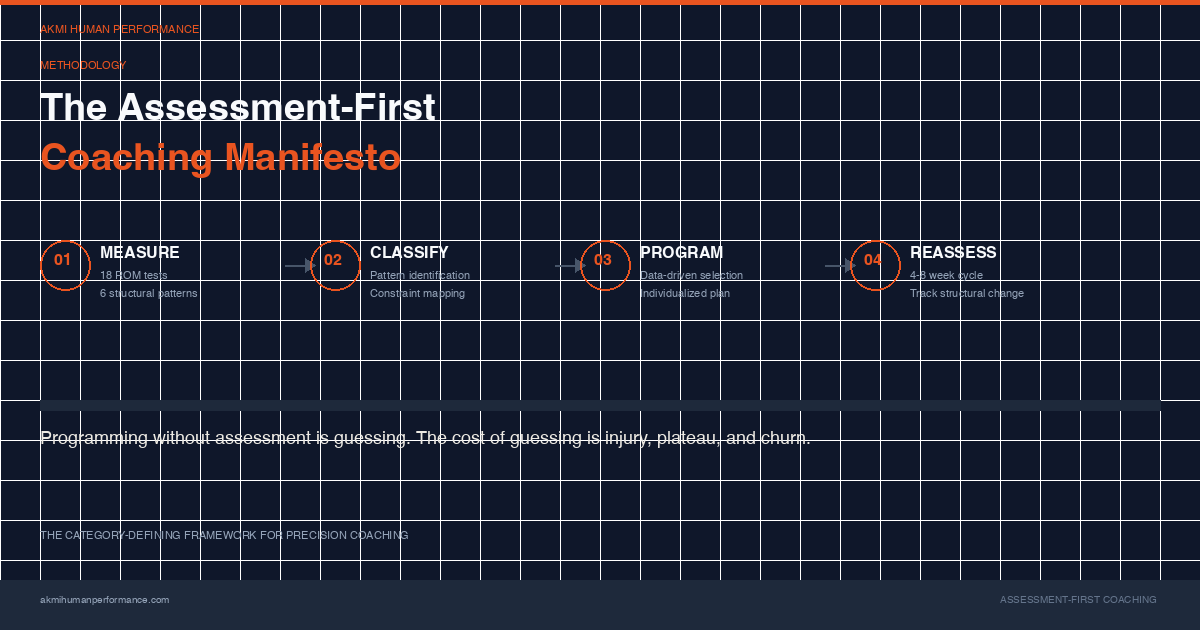
Assessment-first coaching is the alternative. It is simple in principle and demanding in practice: before you program, measure. Before you load, test. Before you progress, reassess. Let the data drive the decisions, not the template.
This article is our manifesto for why.
What “assessment-first” means in practice
Assessment-first coaching is not “do a movement screen on day one.” Movement screens are a start, but they show composite movement patterns without isolating where the constraint lives. Watching someone squat tells you the squat looks restricted. It does not tell you whether the restriction is at the ankle, the hip, the thoracic spine, or some combination of all three.
Assessment-first means component testing. Joint by joint. Range by range. Left versus right. Each measurement is a data point that narrows the diagnostic space and makes programming decisions more precise.
At AKMI, the assessment protocol includes 18 range of motion tests:
- Hip: Flexion, extension, internal rotation, external rotation, abduction, adduction
- Knee: Flexion, extension
- Ankle: Dorsiflexion (knee bent and straight)
- Shoulder: Flexion, internal rotation, external rotation, horizontal adduction
- Thoracic spine: Rotation (bilateral)
- Cervical spine: Rotation (bilateral)
Each test is measured in degrees with a goniometer or inclinometer. The measurements are bilateral, producing 18 data points that feed into a pattern classification system. The system identifies which of six structural patterns the client presents, which has direct implications for exercise selection, load placement, and corrective strategy.
The entire assessment takes 20-30 minutes. The data it produces changes every programming decision for the next 4-8 weeks.
Assessment is not screening
This distinction matters. A screen is a pass/fail binary. Can you touch your toes? Can you overhead squat? Does your knee track over your toe? Screens identify that a limitation exists. They do not quantify it, they do not lateralize it, and they do not connect it to a structural pattern.
Assessment is quantitative. Hip internal rotation is not “restricted” or “normal” — it is 28 degrees on the left and 41 degrees on the right. That 13-degree asymmetry means something specific about pelvic position. “Restricted” does not tell you what to do. “28 degrees left, 41 degrees right” tells you exactly what to do.
The difference between screening and assessment is the difference between a map and a GPS coordinate. The map tells you roughly where you are. The coordinate tells you exactly where you are and how far you need to go.
The cost of guessing
When coaches program without assessment, they are guessing. Educated guessing, experienced guessing, well-intentioned guessing — but guessing. And guessing has costs.
Cost 1: Injury from loading incompatible ranges
The most direct cost is injury. When a coach loads a movement pattern that the client’s structure cannot support, the load goes somewhere it should not.
A client with 20 degrees of hip internal rotation on the right side cannot squat symmetrically to depth. If the coach programs heavy back squats to parallel, the right hip runs out of rotation at about 60% depth. The lumbar spine flexes to compensate (the “butt wink”). Under load, this lumbar flexion compresses the anterior disc wall and tensions the posterior annulus. Over weeks and months of this loading pattern, the disc degrades. The client gets “a bad back.”
The coach blames genetics, training history, or bad luck. The real cause was loading a range the joint did not own. The assessment would have caught it in 90 seconds.
This is not hypothetical. Every experienced coach has seen it. Most have caused it.
Cost 2: Plateaus from programming against structure
When the program conflicts with the body’s structural state, progress stalls for reasons that are invisible without assessment data.
A client with a bilateral extension pattern (ribcage flared, pelvis anteriorly tilted, hips locked in external rotation) will plateau on pressing movements because their shoulder internal rotation is restricted. They can bench press, but they cannot achieve the scapular position that optimizes pec activation. The load bypasses the target muscle and goes to the anterior deltoid and the shoulder joint capsule.
The coach responds by adding more pressing volume. The client presses more with bad mechanics. The plateau deepens. Eventually the shoulder starts to hurt, and the coach switches to “shoulder-friendly” alternatives, which is code for “I don’t know why this happened.”
Assessment data would have shown the shoulder IR restriction before the first bench press was programmed. The intervention would have started with restoring shoulder IR, which would have improved pressing mechanics, which would have prevented the plateau and the pain.
Cost 3: Client churn from invisible progress
The average client leaves their trainer after 4-5 months. The stated reason is usually cost, time, or “I can do it on my own now.” The real reason is almost always: “I’m not sure this is working.”
When the only progress metrics are performance-based (weight on the bar, body weight on the scale, reps completed), progress stalls are existential. A client who has not added weight to their squat in 6 weeks has no evidence that anything is happening. Even if their structure is changing — hip IR improving, asymmetry reducing, pattern shifting — they cannot see it because nobody is measuring it.
Assessment data solves this. During a reassessment at week 8, the coach shows the client: “Your right hip IR went from 22 degrees to 31 degrees. That is significant. Your asymmetry index dropped from 16 degrees to 7 degrees. Your structural pattern is shifting from Pattern 1 toward neutral. The performance gains will follow the structural changes — they always do.”
The client can see the progress. They can hold the numbers. They re-commit. Retention extends.
Cost 4: Professional stagnation
Coaches who program without assessment cannot improve systematically. They can accumulate experience, develop intuition, and get better at guessing over time. But they cannot run the feedback loop that drives genuine expertise: hypothesis, test, measure, adjust.
Without assessment data, every programming decision is unfalsifiable. The coach prescribes hip flexor stretches for anterior pelvic tilt. Did the tilt change? Nobody measured. Did the client feel better? Maybe. Was the stretch the reason? Unknown. The intervention cannot be evaluated because the outcome was never quantified.
Assessment data closes the loop. The coach prescribes repositional breathing for ribcage-driven APT. Four weeks later, the infrasternal angle is measured again. It decreased from 110 degrees to 95 degrees. Hip IR improved 6 degrees bilaterally. The intervention worked — or it did not. Either way, the coach learns something concrete and carries that knowledge into the next case.
Over years, the assessment-first coach builds a database of interventions and outcomes. They know which corrections work, how fast, for which pattern types. The guessing coach has years of experience and the same uncertainty they started with.
The five principles of assessment-first coaching
Principle 1: Measure before you program
Every new client relationship begins with a structural assessment. No exceptions. Not after the first month “once we get to know each other.” Not “if something hurts.” Not “for the advanced clients.” Every client, every time.
The assessment is not a sales tool or a screening ritual. It is the diagnostic foundation of the program. Without it, the program is a guess.
Principle 2: Quantify, don’t qualify
“Tight hips” is a description. “28 degrees of hip internal rotation on the left, 41 degrees on the right” is data. Descriptions invite interpretation. Data drives decisions.
Every assessment finding should have a number attached to it. That number makes the finding objective, comparable over time, and communicable between coaches. When a client transfers from one assessment-first coach to another, the data transfers with them. When a client goes to a physiotherapist, the coach can send ROM measurements, not subjective impressions.
Principle 3: Program follows pattern
The six structural patterns are not labels. They are programming frameworks. A client in Pattern 1 (bilateral extension) needs different exercise positions, different breathing strategies, different load placements, and different progressions than a client in Pattern 4 (posterior chain dominant) or Pattern 2 (left-dominant asymmetry).
The pattern determines the corrective strategy. The corrective strategy determines the exercise selection. The exercise selection determines the program. The chain runs from assessment to program, not from goal to program.
This does not mean ignoring the client’s goals. It means routing the goals through the structural reality. “I want to squat heavy” is a valid goal. “I want to squat heavy, and your right hip IR is 20 degrees below minimum for symmetrical depth, so we are going to restore that range before loading full-depth squats” is an assessment-first response to that goal.
Principle 4: Reassess at regular intervals
A baseline assessment is useful. A longitudinal assessment is powerful. Reassessing every 4-8 weeks creates a structural timeline — a record of how the body is changing in response to the program.
The reassessment serves three purposes:
- Outcome verification: Did the intervention work? The data shows improvement, stagnation, or regression. Each outcome informs the next programming cycle.
- Progression authorization: Has the client earned the next phase? If hip IR has improved from 22 to 32 degrees, they may now have the structural clearance for deeper squats or wider stance deadlifts. Without reassessment, the coach either progresses too early (risking injury) or too late (wasting time).
- Retention reinforcement: Showing a client their structural progress in numbers renews their commitment. This is the most underrated benefit of reassessment.
Principle 5: Build the system, not the workout
Assessment-first coaching is a system, not a collection of techniques. The assessment protocol, the pattern classification, the programming rules, the reassessment cycle, and the data tracking form a closed-loop system where each component feeds the next.
Individual workouts matter less than the system they are part of. A brilliant workout programmed outside of a system is noise. A good workout programmed within a system that tracks structural change over time is signal.
The system is what makes the practice scalable, teachable, and reproducible. Any coach can learn the assessment protocol. Any coach can apply the pattern classification. Any coach can run the reassessment cycle. The system does not depend on guru intuition — it depends on measurement, classification, and response.
Objections and honest answers
”Assessment takes too long. Clients want to train, not get tested.”
The full assessment takes 20-30 minutes. A typical onboarding session at most training facilities takes 60 minutes and is mostly paperwork, goal setting, and a “trial workout” that tells the coach almost nothing structural. Replace the trial workout with an assessment, and you have used the same time to generate 10x more useful data.
Clients who resist assessment are telling you something: they do not understand the value. The first time you show a client their bilateral hip rotation data and explain what it means for their squat, the resistance disappears. They have never had a trainer take this seriously before.
”I can see movement problems without measuring.”
You can see compensations. You cannot quantify them, lateralize them, or track them over time. A movement screen tells you “the squat looks restricted.” An assessment tells you “the squat is restricted because right hip IR is 18 degrees below normal, ankle dorsiflexion is symmetric and adequate, and thoracic rotation is limited 12 degrees on the left.”
Visual assessment and quantitative assessment are not competing methods. They are complementary. Use both. But build the program on the numbers, not the impression.
”My clients are general population. They don’t need this level of detail.”
General population clients are the ones who need it most. Competitive athletes have sport coaches, strength coaches, physiotherapists, and medical staff monitoring their bodies. A general population client has you. If you do not assess them, nobody will.
The 45-year-old desk worker with bilateral hip IR restriction is at higher risk from unassessed training than the 22-year-old college athlete, because the desk worker has fewer resources, less body awareness, and more accumulated structural compensation. The assessment protects the people who need protection the most.
”The assessment findings are too complex to act on.”
If the assessment protocol is well-designed, the findings map directly to programming decisions. Pattern 1 → specific exercise list. Pattern 2 → specific exercise list. Bilateral IR restriction → specific corrective sequence. Asymmetric shoulder rotation → specific modification for pressing.
Complexity at the assessment level produces simplicity at the programming level. Without assessment, the coach faces infinite programming options and no data to narrow them. With assessment, the structural pattern eliminates 80% of the options and highlights the 20% that match the body.
The category we are building
Assessment-first coaching is not a feature of the AKMI platform. It is the category the platform exists to serve.
The coaching software market has spent a decade building better program delivery tools — prettier apps, smoother workout tracking, more efficient template systems. These tools make it easier to deliver programs. They do not make the programs better.
We are building the infrastructure for a different kind of coaching: one that starts with structural data, programs from that data, tracks structural change over time, and closes the loop between assessment findings and programming outcomes.
The AKMI methodology is the clinical framework. The platform is the technology that makes the framework scalable. The free tools are the entry point for coaches who want to try assessment-first coaching without committing to a platform.
If you coach, you should assess. If you assess, you need a system. If you need a system, we built one.
Start here
If this resonates but you have never run a structural assessment, here is the starting sequence:
-
Tomorrow: Test hip internal rotation on your next client. Seated, 90 degrees of flexion, goniometer on the patella. Measure both sides. Write down the numbers.
-
This week: Add hip external rotation and ankle dorsiflexion to your testing battery. You now have a bilateral rotation and mobility profile for the lower extremity — 6 data points that tell you more than a full FMS.
-
This month: Try the AKMI ROM Estimator. Enter the measurements you have been collecting and see the structural pattern probability. Compare the pattern suggestion to what you observe visually. Notice where they align and where they diverge.
-
Next month: Run the full 18-test assessment on your most complex client — the one with the recurring issue you cannot figure out. See if the pattern classification changes your perspective.
-
In three months: Reassess. Look at the trend. Ask yourself whether the data made your programming better. If yes, you have your answer. If no, you lost nothing but learned something.
Assessment-first coaching is not a theoretical commitment. It is a practical one. Start with one test, on one client, tomorrow. The data will tell you whether to continue.
The AKMI ROM Estimator is free. Enter range of motion measurements and get structural pattern classification in seconds. Read the complete assessment guide for the full 18-test protocol and pattern system.
Strategic consultant specializing in growth, profitability, and internationalization. Creator of the assessment-first coaching methodology used by AKMI Human Performance. Background in business strategy (MIT Sloan) and applied biomechanics with over 10 years of hands-on coaching experience.
View all articlesRelated Articles
View all ->Ankle Mobility for Deeper Squats: What You Are Actually Missing
Limited squat depth is blamed on tight ankles. The real limitation is usually the hip, the rib cage, or the way your nervous system organizes the squat pattern — not the ankle joint itself.
AssessmentBiomechanical Assessment vs FMS: What Is the Difference?
The Functional Movement Screen and a biomechanical assessment look similar from the outside. They are fundamentally different in what they measure, what they tell you, and what they miss.
Sport PerformanceBasketball Injury Prevention: A Structural Approach
ACL tears, ankle sprains, and patellar tendinopathy dominate basketball injury lists. All three share the same structural root: hip and pelvic mechanics that fail under lateral and vertical demand.
BusinessBuild a Coaching Business Around Biomechanical Assessment
Assessment-based coaching commands premium pricing, retains clients longer, and creates a defensible niche. Here is how to build the business model from scratch.